Wednesday, 8 September 2010

The Launch of ASOS Black


The continued rise of ASOS is nothing short of remarkable. Launched just over a decade ago as a small online retailer catering for people who wanted to dress like celebrities, the store has evolved in to an online retail powerhouse. The unique selling point has always been fast, affordable fashion but in recent seasons we've seen the measured introduction of more directional fashion. While offering an array of mouth watering design talent, ASOS' own label has evolved to such an extent that it has to be taken seriously. This Autumn, the store unveils its own line of directional pieces that have left me reaching for my debit card.

ASOS Black was borne from the desire to explore the finer aspects of modern menswear. Precision of cut, fabrication and fine detailing are key facets that excite us all and thankfully that includes ASOS' talented design team. Consisting of around forty pieces the collection concentrates on crisp tailoring. Classic double breasted suit, milled end on end for enhanced texture. A tuxedo suit that combines wool with crushed metal trims. Outerwear is minimal in detail and highlights include a wrap coat that lacks any form of front fastening and a contrast panel Crombie in black and navy creating subtle differences of tones. Knitwear is oversized and slouchy. There is just so much to get excited over. To mark the launch of the line we met up with one of the creative minds behind it all, head designer John Mooney, to talk us through it all.


SS: What was the starting point for ASOS Black?
John Mooney: The whole ideas was to provide something new and contemporary for our creative customers who wanted all the new shapes, cuts and silhouettes from the catwalk shows, and they wanted them now. Through our research it seemed apparent to hone down the palette and keep it minimal with the idea of it being a progressive collection that pieces could be added to each season. We also pattern cut the range in London so have control over the shape and cut which has allowed us to develop a unique fingerprint for the collection.

SS: What does Black mean to you?
John Mooney: If I am honest, it is pieces that we in the design team and design community want to wear… All the pieces that we can’t put in mainline ASOS we can put into Black but it must be part of a considered range and one that works as a complete whole from season to season.


SS: What was the first item designed? And the last?
John Mooney: The first item designed for Black was a single button double breasted jacket as we knew there would have to be a tailored aspect to the range to ensure that it felt contemporary… The last items were printed t-shirts and a vest as we wanted to inject another element into the range and collaborated with an external print designer.

SS: Describe the collection in a few words?
John Mooney: Slick, relaxed, tailored and new.


SS: How did you balance the luxurious feel of the collection and quality with commercial constraints?
John Mooney: It is a little bit more expensive than our mainline collections but this is more due to the precision of cut and the fact that we have expanded our supplier base so that we have the best people working on the collection. We wanted not only to make it a great collection but that it was affordable too so that customers of the ASOS own line could buy into it. It’s always a challenge to achieve certain price points in this day and age as the market becomes ever more competitive but thankfully we are not a bricks and mortar business so we are able to put that money into the product itself.

SS: What are you particularly proud of or excited by?
John Mooney: I am proud of the whole thing, but it is also about the whole team who worked together on the collection. I am proud of the way everyone came together to ensure the collection was produced. This sort of collection pushes the team and this translates through to our own collections.


SS: Why did you produce a video to promote the collection?
John Mooney: The video is meant to emphasise the atmosphere and aesthetic that underscores the collection. It is visually beautiful and contrasts the softness of some of the pieces with the harder visual elements.

SS: Finally, how do you see it developing over the coming seasons?
John Mooney: We do see it as a progressive collection – there will be a common thread so that the SS11 collection should work with pieces from AW10 as they are all designed with a similar design aesthetic...
__________

The mood is dark, the shapes angular and the prices affordable. This is a huge step forward for online retailing and I can't wait to see it evolve even further in future seasons. To mark the launch of Black, ASOS have commissioned Paul Gore to produce a short and suitably moody promo which we will be able to share with you early next week.

ASOS Black will be available to buy in approximately nine days time.

Tuesday, 7 September 2010

In discussion: Neglected items of clothing


The desire to develop a dialogue around men's style and fashion has always been one of our key motivations to blog so it is only fitting that we mark the latest incarnation of the blog with a discussion. With this in mind, we have rounded up the musings of a selection of designers that we have met along the way in the hope that it will kick start the conversation on those neglected or long forgotten items of clothing and accessories...

______

"Neckerchiefs - they have a beautiful sensibility about them that is often mistaken for overt femininity and so are consequently often disregarded as a staple wardrobe piece."
Charlie Casely-Hayford, designer, Casely-Hayford

______

"Camo trousers are always the best seller in all the collection, summer and winter it doesn't matter."
Stefano Ughetti, designer, Camo.

______

"Hats. Being part of the Kangol team for many years opened my eyes to the wide array of headwear out there to suit pretty much everyone’s face and style. Photos of men in the 1930’s or earlier show that virtually everyone wore hats – and looked fantastic with it."
Jorrit Jorritsma, designer, Millican

______

"Jewellery in general but rings in particular. I love men in rings. I always start with rings when I design a collection. Men tend to struggle with them because it might be easier to wear a pendant, they are used to wearing a watch so things around the wrist are far easier. Using my boyfriend as an example, I made him a ring and he was completely overwhelmed by it. He had a real fear of rings but thankfully I got him over it, so the story has a happy ending. He used to have a real fear of anything on his fingers but now he can't leave the house without it. I love signet rings and anything on the little finger for men works extremely well. Rings are still something of a sticking point. That sovereign ring is quite a piece to wear but looks amazing."
Hannah Martin, jewellery designer.

______

"Well I’m quite keen on coloured socks and also patterned ties, and if they match then even better! I developed a couple of knitted ties in our spring 10 range and I haven’t stopped wearing them. Anything with a nod to ‘Dandy’ works for me."
Nick Thomas, designer, John Smedley.

______

"Breeches. We love them. Who says there only for the riding paddock or the golf course? I’m pretty sure Chris is trying to bring the perm back too."
Luke Stenzhorn, designer, Percival.

______

"Jackets..good blazers, all the time. Hats as well. A good hat is a lot of fun but you just don't see it anymore. For us though, the hats have done spectacularly well. I guess they are brightly coloured so stick out to people but it is great to see."
Alexia Hentsch, designer, Hentsch Man.

______

"A jacket and trousers that are the right length and fit for their body and personality."
Jsen Wintle, designer, Wintle.

______

"It's got to be a hat, a good hat always finishes off an outfit. Guys are getting better over here but not a patch on Japanese men."
Harris Elliott, accessories designer, H By Harris.

______

"A Belt. I cannot stand seeing a gent with his trousers around his ankles......."
Lou Dalton, designer.

______

"Good shoes. I'm sorry chaps, but you can't get away with it. As a wise man once said to me 'Only a rich man can afford to buy cheap shoes'"
Carolyn Massey, designer.

______

Monday, 6 September 2010

Ute Ploier as the masculine heroine

The display of Ute Ploier's Autumn 2010 collection as photographed by Guenter Parth

We might all be warming up our well relaxed muscles for the impending fashion month but in the middle of stretches and star jumps I encountered a selection of images from last season's presentations that focused my attention back on AW10. Until today, Paris was a distant memory. After hazily looking back over scribbled notes and bookmarked sites it is quite clear that the goings on in the French capital were largely overlooked on these pages. No more. Thanks to the good people of Cultures In Between my eyes have been treated to Ute Ploier's Aw10 presentation and the photography of Guenter Parth. I just had to share them.

Clothes as second skin. Guenter Parth cleverly attibutes Ute's garments as anthropomorphic ensembles.

"What we wear is more than just fabric. It is the idea of how we want to be perceived by others. The fabric, the colour, the details, the styling – everything tells a story about the person wearing it. My collections play with dress codes and crack them up. My work is about liberation because it is about creating more freedom of choice and moving away from stereotypes of masculinity."
Ute Ploier

My favourite look sees a mixture of fine mohair and wools in a black and white flecked blazer, a quilted tartan coat andboxed cut double breasted jacket.

Ute Ploier has always been a designer that thrives on the challenges of menswear, pushing the boundaries in a subtle manner to create garments that can be worn by all types of men. The display demonstrates the designer's preoccupation with craftsmen, the fabrics they wear and the industrial materials that both utilise and create. Despite not having a body to wear them, the designer has created a collection that is full of life. Dealing with male archetypes, boxers or craftsmen, Ploier deconstructs and recreates. Assuredly masculine garments are made, and her stories told, with the utmost respect and precision.

Protected from a downpour. Waxed cotton outer jacket.

The fabrics showcased in these images intensify my longing for the cooler days. The collection of luxurious fabrics from the UK, Italy and Austria reads like my ideal season shopping list. Finest alpaca, mohair, merino wool, waxed cotton, leather, washed Oxford for shirting. While the colour palette is rich and dark, different shades of brown, gold, purple, black, midnight blue, rust all whet my appetite for those moments where boots crush crisp, fallen leaves.

Long sleeved mohair sweater and dark charcoal woolen trousers and gold geometric jewellery

For a few moments I have forgotten all about fashion month and SS11. It is time to live in the near future. It is, almost time to wrap up in layers of soft fabrics and seek protection from waxed cotton and leather. It is time to get excited by Autumn.

Friday, 3 September 2010

The Craft of Cheaney

Exactly one week ago I shared the news that Joe Casely-Hayford for John Lewis would be returning for the new season. The sophomore collection of this intriguing collaboration once again celebrates true craftsmanship and home grown British manufacturing. With collaborations with remote mills in Yorkshire, tartan experts in Selkirk and respected bag maker Chapman to name but a few, the collection once again brings seemingly specialist products to a wider audience without losing any of the integrity that make their products special. The Cheaney brogues typify why this capsule collection is so exciting: the collaboration of great British design talent with heritage brands coming together for the high street. During my excited ramblings I mentioned the fact that I was invited to watch the Cheaney craftsmen at work at their Desborough factory. I eagerly followed and snapped away at each well honed and practiced process from start to finish in the factory that has been their home for well over two hundred years.


Before I offer an abundance of 'factory porn' and talk you through the processes of what makes Cheaney footwear special I have to acquaint you with the brand and give you a little background. The name might not feel that familiar on first reading but I'm quite sure that you've seen or indeed worn their work without even knowing it. In addition to making fine, bench made shoes under their own label, the factory sees them create footwear for the likes of Gieves & Hawkes, Paul Smith, Jeffrey West and more recently Lodger. As I strolled through the space and watched the one hundred plus workforce in action it became apparent that Cheaney are a classic English shoe brand undergoing something of a quiet and assured metamorphosis under the ownership of William and Jonathon Church. Founded in 1886 by two brothers, Joseph and Arthur Cheaney, Cheaney quickly became one of the premier shoemakers of England. It is their ability to blend the past with the future, using the finest materials available, which has enabled them to become and remain one of the premier producers of Goodyear welted shoes in the world today. On a point where some of their competitors have wandered, both William and Jonathan Church are fully committed to producing footwear entirely made in England. They believe that moving offshore would lose the essence of the brand. The craftsmanship and well honed skills are essential to the product and it was a pleasure to be able to watch it all unfold in a space that has seen the same processes come together for over two centuries. It is little wonder why Casely-Hayford partnered with them.

Cheaney represent the height of English Bench Made shoe making. It takes eight weeks to make a pair of Cheaney shoes, it involves around one hundred and sixty hand operations, from cutting the leather through to finishing, combining the best of contemporary design with superb quality. Given how much of a factory pervert I am, you can only imagine how many photographs I took as William Church guided me through and in to the nooks and crannies of this well oiled assembly line of true craftsmanship. I have managed to hone them down and will now use them to guide you through the main shoe making processes.

What makes a Goodyear wellted brogue?

The first construction stage is clicking and this is the process where the leather is cut. The term clicking refers to the sound made by the knife. Depending on the shoe, this stage can be performed by a press knife – a pneumatic machine that effectively punches through the leather like a cookie cutter or by hand and I watched both practices performed during my stay. It was amazing to watch how the craftsmen made use of the hide. During this stage it was different aspects of the hide and the fact that the skill of the craftsmen ensures that the best of the leather is used for the uppers (as a rule, the further back you go on the animal, the better the quality of skin) and that there is minimal wastage.

I was surprised at how much of this was still performed by hand.

I took a peculiar amount of delight in marveling at this table of components

Clicked leather, ready for the next stage...

The next stage is closing. The is where the various parts of the upper are sewn together. With a bespoke shoe it would be done by hand, but every other type of shoe is closed by machine. I was amazed at how precisely yet quickly the machinists turned the clicked leather segments in to recognisable shoe forms.

The upper begins to take shape.

The embellishment of the upper.

Given the intricacy of the pattern it was mind blowing to see how fast the ladies transformed the uppers.

Another closing scene that is only just the beginning for this shoe.

The next stage is lasting. As I entered this intimidatingly large and machine heavy part of the factory I was instantly taken by the dominance of one gender, males. The prevalence of women in the 'closing' area had gone seemingly unnoticed but the moment I stepped in to this space, the lack of women was obvious. I'm just not used to being in such gender defined environments. As I manoeuvred my around the testosterone I was able to watch what makes Great British shoemaking so great.

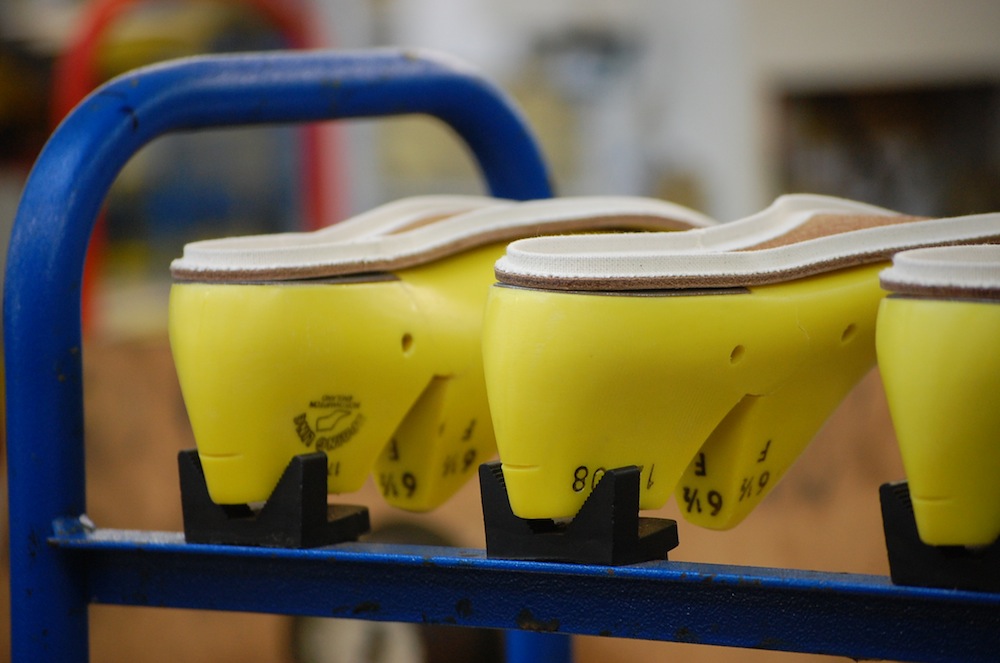
The lasts.

Throughout the shoe making process the leather loses moisture so here the uppers are placed in a steam machine to soften the leather.

The uppers are then pressed and pinched on to the last...

The shoe is readied for the welted sole with the help of a few staples...

A closer look at the early stages of the lasting process.

Any wrinkles are smoothed out before the iconic lasting stage...

Goodyear Welting is, after two hundred years of shoemaking in Northampton, still considered the finest method of shoe construction. Once the upper leather has been ‘closed’ it is placed onto the wooden last and the insole is attached. A strip of leather called the ‘welt’ is then stitched through the upper leather to the underside of the leather insole. The outer sole is then stitched to the welt. This ‘Goodyear welting’ is time consuming and requires highly skilled craftsmen. However it means the sole can be replaced time and again without damaging the upper leather. As the leather components are stitched rather than glued together all the natural properties of the leather are retained, giving superior thermal insulation, durability and shape retention, as well as the best possible breathing conditions for feet. The more a Goodyear Welted shoe is worn, the more comfortable it becomes as the leather components gradually mould to the shape of the foot.

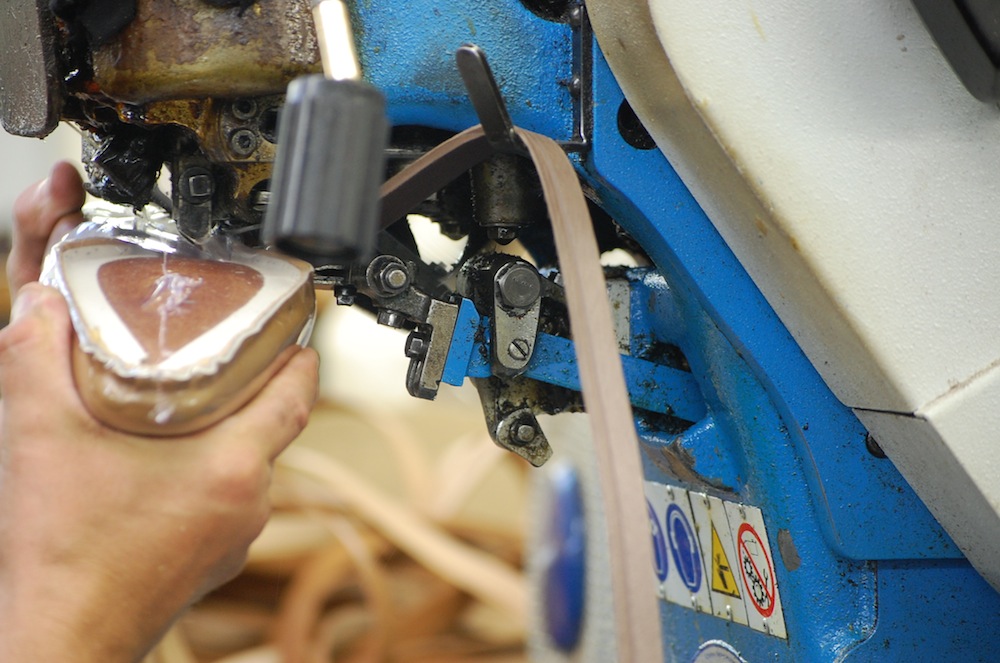
A closer look at the highly important welting.

The welt is fed and stitched using this ingenious machine. I watched this process over and over again.

This process is so important to English shoe making

The under sole is then prepared for the outer shell.

A strip of wood is inserted to ensure a better structure before the outer sole is glued in to place.

The excess from the outer sole is removed

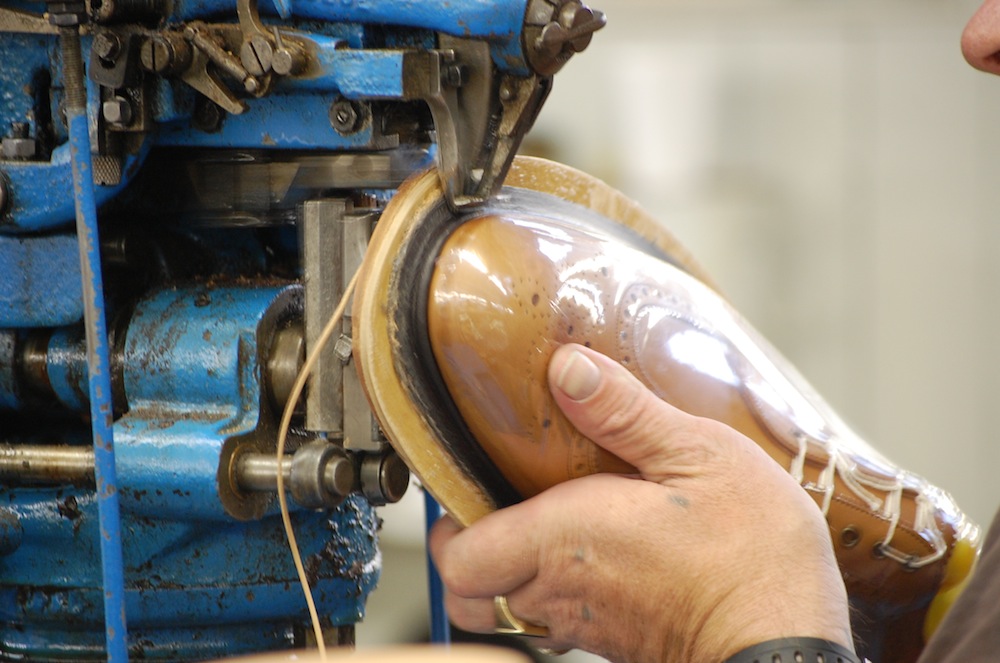
The next stages sees the welt sewed to the upper, and both to the sole. I was told that doing this by hand takes a great deal of time and this is an area where industrial advancements have really helped. Each stitch has to be locked, using two threads that effectively create a knot at every stage. Doing it by machine takes a matter of minutes, so almost all bench made shoes do it this way. It is no less impressive though.

The machine in action

A closer look at how the stitching is locked

We then move on to the final two stages, the bevelling of the waist and polishing of the the upper. These processes should not be underestimated because they combine to provide the distinguishable aesthetic of English made shoes very special indeed. Bevelling is a particular treatment of the waist of the shoe, specifically that part of the sole at the waist lying between the flared-out ball-of-the-foot area and the heel. The treatment is one in which the sole at that point is shaped into a quite convex form, with the bottom of the curve right in the middle (from side to side), and the sole curving up at the edges.

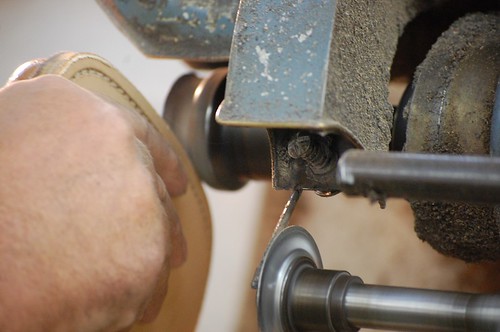
The sole and heel are sanded and smoothed using various machines.

The heel takes shape.

The surface is smoothed and rounded

The attention to detail and reliance on the craftsman's eye are key at this point.

A more recognisable form. Simply stunning.

Applying the finishing touches to the sole.

On to the burnishing of the upper. I've never seen polish applied so quickly and enthusiastically.

The final product ready for packing.

Notice the variety of designs.

During my time at the factory I was able to see firsthand snapshots of the creation process for the latest Joe Casely-Hayford for John Lewis, Cheaney brogue. The Mentor shoe is a new take on the classic Oxford. It showcases sophisticated design elements including an integral punched toe cap and a chamfered Goodyear Welted sole to make a shoe both wonderfully stylish yet practical. I was fortunate enough to view the finishing touches being applied to one of the final dozen due to be dispatched to John Lewis, ready for sale later this month...

A final inspection.

A quick finish to ensure perfection in each and every shoe.

The Mentor shoe will be available to purchase very soon.

Using only the best available materials, including calf upper leather and oak bark tanned soles, Cheaney’s craftsmen apply their skills to produce handmade and benchmade shoes which maintain a standard seldom equalled in the world of Goodyear welted footwear. As I walked through and looked on at each process of construction, the balance between old but proven techniques and machinery from various eras since the industrial revolution, really left a lasting impression on me. This is a company that continues to learn and strive for the highest quality in an environment that has changed very little in well over two hundred years. It was a real pleasure to watch them work and after spending a few hours there, it is obvious why Joe Casely-Hayford chose to work with them once again for this project.

Thursday, 2 September 2010

Discovering Bunney in time for LFW

I don't want to alarm any of you but somehow we have stumbled in to September. How on earth did that happen? This means we are only a matter of days away before fashion month engulfs us all. If that was not exciting (daunting) enough we are learning about new additions to the LFW menswear lineup each and every day. The latest comes from the Touba Distribution curated Showroom Next Door who have now released their full list of participating brands. You should recall that last season, the space became my dream walk-in wardrobe the moment I stepped through the doors of 16 Hanover Square, with a few new additions to the lineup it looks as though this season will have the same affect. I have to warn you in advance that the list causes heavy breathy and heart palpitations. Casely-Hayford, Sable Clutch, Mr Hare, Armando Cabral, H by Harris, Hannah Martin, Bruno Chaussignand and Bunney. To further enhance your heart beat, I'd like acquaint you all a little closer with Bunney's jewellery line...


While making clothes for quite some time in various design positions at Gimme 5, Bunney always found himself attracted to jewellery. For him however, it was far too one-dimensional and rigid. Ultimately, Bunney was drawn to the idea of coming up with something everybody or anybody could wear. So, for the last few seasons, Bunney has been quietly navigating an elegant and refined men's jewellery offering with his range of silver pyramid stud pins sold in sets of three at Dover Street Market, Tokyo’s F.I.L.and Colette in Paris. Bunney says the concept focuses on giving freedom to the wearer “you wear them how you want, on a jacket or a shirt, together or separately”. To celebrate his inclusion at LFW, we decided to sit down with the designer to learn more about the processes involved in his creations and to learn what else he has in store.


SS: How has the line evolved since its inception?
Andrew Bunney: I started with one item in the beginning - a large size silver pyramid stud which comes in a set of three. I've gradually added more sizes and materials, and I will be showing a small range for the first time later this month. I wanted to try and make something quite unisex, and coming from the UK I always like the way in which people can take things and wear or use them in a way unique to themselves.


SS: Could you talk us through a few of the process involved in the creation of your pieces?
Andrew Bunney: To date, the ideas have been from some of the simple things that we know, and thinking about how to address them using precious materials. So from the idea and my designs, I work with a jeweller to see what the best method of manufacturing will be each time. Some of the items are made employing techniques that are usually used for making a different kind of product, so depending on the item I learn and see a new method of construction.


SS: Made in England is a fundamental facet of the label and I know that you've searched for the craftsmen to help make your designs a reality. How much of a struggle has this been and were you surprised by how tough it was?
Andrew Bunney: I wouldn't be interested in making something in England simply for the sake of it. Certain places or countries excel at different things and I want to make everything as well as possible. I approach 'Made In England' knowing that there is a long history and tradition of producing jewellery in England so I spend a lot of time to find some of the finest workshops.

On a personal level, the manufacturing side is very interesting to me, and I enjoy visiting different workshops around the country to learn what can be made and the possibilities that there are. Because the trade is much, much, smaller than in years gone by, there are always difficulties and some traditions or techniques have disappeared. I'm quite sure that it would be easier to produce things more quickly in other countries, but sometimes it is about establishing relationships too.


S: Could you explain your association with 'Uniform experiment'?
Andrew Bunney: Uniform Experiment is a mens clothing company based in Japan, and for a special release later this year they asked me to produce some gem-stone studs for them. Based on the existing stud styles, the stones are cut into the pyramid shapes, then set by hand in a special silver mount. The sets come as either Onyx + Carnelian (red), Onyx + Topaz (blue), Onyx+ Amethyst (purple).


SS: Finally, where can we find your designs?
Andrew Bunney: To date, Bunney has been selling to DSM, Colette and the F.I.L. stores in Japan and HK (the Visvim own brand shops).

Look book shot taken by Marius W. Hansen. All other previous images shown above shot by Tommy.

----------


The news of Bunney's inclusion at the the Showroom Next Door has pushed us over the edge. Roll on London Fashion Week.

LinkWithin

Related Posts with Thumbnails