Wednesday, 23 June 2010

Exclusive: London belongs to Paris...for now

As our collective eyes shift from the colourful happenings of Milan to the runways and showrooms of Paris, a significant number of London designers are making their way over to the fashion capital to join the lineup. Among them is the ever fabulous b Store. This season sees b Store collaborate with filmmaker Ivana Bobic and architect Tom Finch on a video and set installation to showcase the new SS11 collection. Inspired by Derek Jarman’s music videos for The Smiths, and London’s iconic architecture, their work reinterprets this season’s key influences to create an environment perfectly tailored to the garments displayed within it. We might be missing out on the debut screening and subsequent party this Saturday but we are pleased to share the first look at the new collection...

London Belongs To Me...a look from b Store SS11

Easy to understand and wear, we are told b Store's SS 2011 menswear collection is a return to the simple principles behind the brand. Loose fits, transparent layers, and saturated over-dyed checks and florals reference early 90s post-club London during its transition from the unrefined feel of baggy, to a smarter casual aesthetic. Relaxed silhouettes are combined with washed poplin, linen, and denim to emphasise this subtly sophisticated approach. Fabric mixing updates shirting, with sheers layered over prints and spliced pattern blocking softening the look. Waffle knit Breton cut pullovers have a slouchy appeal, complimented by a range of sharp graphic tees with panels of monochrome print or polka dots. With a worn and lived-in appeal making the pieces more accessible and versatile than ever, the sharp wardrobe essentials and clever basics reflect a softer, less strict mood that is ideal for the warmer months...


London Belongs To Me...a look from b Store SS11

I don't know about you but these two images have certainly whet my appetite for the rest of the collection. We might be missing out on the showcase itself but b Store will be anything but lonely in Paris. The LONDON ShowROOMS has been successfully running for four seasons now but SS11 sees it extend to include some of the best emerging menswear talent in the UK. The scheme, a joint collaboration by the British Fashion Council, Fashion East and The Centre for Fashion Enterprise is taking fourteen designers to show in Paris include Bernstock Speirs, Blaak, BOYOstudio, Carolyn Massey, Christopher Kane Men's, Christopher Raeburn, Miharayasuhiro + husam el odeh eyewear, James Long, Katie Eary, KTZ, Lou Dalton, Omar Kashoura and Tim Soar. Similarly, Esquire and Colin McDowell present a catwalk film of seven British menswear designers currently not showing but who should be seen. The magnificent seven includes Richard James, Domingo Rodriguez, E. Tautz, Oliver Spencer, Gieves & Hawkes, Baartmans & Siegel and Hart Savile Row. There are so many Style Salvage favourites included in these two lineups. I am confident that these menswear initiatives will give our innovative menswear designers the means to further their global profile and businesses. These are exciting times for London menswear as it will soon reign supreme over Paris.

Tuesday, 22 June 2010

Discovering Pitti: CAMO

Finding CAMO at Pitti Uomo

Pitti Uomo's Who's On Next/Pitti Uomo is always an exciting contest dedicated to new talents – Italian or Italian-based – in men’s fashion, promoted and organised by Pitti Immagine in collaboration with AltaRoma and Uomo Vogue. Competition in the contests second season was particularly fierce with FQR by Fabio Quaranta winning the award for pret-a-porter and AI_ by Andrea Incontri winning the award for accessories. One ready to wear label that really caught my eye was CAMO. Now, I have to confess that I was recently introduced to the brand while examining Topman's recently expanded Premium Brands offering. Sitting proudly alongside the likes of Velour, Soulland and North Sea Industries, Camo's fine knitted pieces and double button colourful trousers were particularly impressive. If my appetite was whet for this brand, Pitti Uomo gave my sartorial stomach a satisfying feed and also gave me the opportunity to talk through the latest collection with the designer. For SS11, designer Stefano Ughetti examined the roots of Biellese farmers and shepherds living a simple and proud life. Through using fabrics made in North West Italy, Stefano celebrates his heritage while supporting local industry and Italian craftsmanship. Here we talk to the designer about his experiences at Pitti, creating his SS11 collection and his hopes for the future...

Camo's Country Collection S/S 2011 hanging in the exhibition space.

SS: Camo is your first foray in fashion design. Tell us a little about your background and how you the label came to be?
Stefano Ughetti: Of course. I was born on 11/07/1974 in Biella (North West Italy). After studying at "Vaglio Rubens" Technical Institute for Geometry in Biella and one year studying at the University of Economy & Commerce in Torino, I started to work in 1995 for an interior fabrics company called Arazzo snc. Between 2000 and 2004 I worked for Viceversa Edizioni Design Spa Home design company. In 2005 I founded Superstar, a concept store for menswear, located in Via Italia 82 in Biella. In 2007, I created my own line: Camo.

SS: How did it all start for you? What were your inspirations, your dreams and the driving catalyst behind launching CAMO?
Stefano Ughetti: My purpose for creating CAMO was not to dress people, but to put them in touch with what they wear. My father is painter, my grand father was an artist, for me I found this way to communicate my ideas to the world.

A closer look at the Country collection

SS: What does Camo mean to you?
Stefano Ughetti: Camo is the abbreviation of “camouflage” which means: disguised, camouflaged. It is pronounced in the same way in all the languages of the world and it is often used to indicate a specific pattern of any product. You can find it in different colours but it remains always the same because it is a thought, an idea. My Idea. People have to be camouflaged in their society inside the rules of them but they still want to communicate themselves so this is my purpose for Camo.

SS: What were the first and last item you remember designing?
Stefano Ughetti: The first thing was a simple t-shirt. Everyone can start tomorrow morning and decide to be a designer, the first simple thing that you can do is a simple stupid t-shirt. The last thing was an elegant gillet for my new collection: Camo Country Collection S/S 2011.

My favourite look from the collection

SS: Craft, local manufacture and Italian fabrics are obviously very important to you. You must work with some extremely small and remote factories. Is it difficult to find them and how has your relationships grown over the seasons?
Stefano Ughetti: Yes it's very very difficult to find local fabrics manufacturers and once I found it is difficult convincing them to work for you! After doing that the road was much easier to follow.

SS: You've just taken part in Pitti Uomo which saw you nominated for Who's on Next/Pitti Uomo? How was the experience and the reaction to the collection? Did you get much of a chance to see other brand's offerings?
Stefano Ughetti: It was a really good experience for me to have the opportunity to show my collection at such a big event. This was my third time participating at Pitti. Who's on Next was a great experience for me arriving in second place but everyone of the four finalists were winners!

I particularly love Stefano's fabric choices

SS: Talk us through your latest collection and how the country inspired you.
Stefano Ughetti: Camo Country Collection S/S 2011 took inspiration from the Italian film “L'albero degli zoccoli” of Ermanno Olmi and from studying the books of “Lassù gli ultimi” and “Fame d'erba” of Gianfranco Bini. The “Country Collection” teaches the tight link between who we are and where we come from: the motherland as language, civilization and customs. It is a deep look in to the roots of the Biellese community of the farmers and shepherds living simple and proud life.

SS: What are your favourite pieces from the collection or is there anything that you are particularly proud of?
Stefano Ughetti: I'm totally proud of all my collection, especially the shirts and jackets.
I also love the cover and beanie for summer, in the style of a shepherd. I like to be a touch ironic in the design of my clothes.

A look at the SS10 look book.

SS: How do you see the brand developing over the next few years?
Stefano Ughetti: I am following my road, but I don't know where it will lead.

SS: Is there an item of clothing or accessory that you’d like to see more men wear?
Stefano Ughetti: Camo trousers are always the best seller in all the collection, summer and winter it doesn't matter.

SS: Which fellow brands/designers do you admire?
Stefano Ughetti: Yuketen, Engineered Garments and Our Legacy. I really like them and we have become friends.


A look at the SS10 look book.

SS: If you could go back in time and experience any moment in style or fashion movement, what would it be? .
Stefano Ughetti: I would want to be in the present now. For me the life of the people present, past and future are emotionally the same, but diverse in the way we do the things.

SS: Finally, would you be able to share a few address book recommendations to our readers (hairdressers, tailors, cafes…anything you like really) which we will duly add to our map?
Stefano Ughetti: About hairdresser's I cut my hair myself, so everyone for me can try to do it themselves. When I am in London I like to go eat a cheeseburger in Brick Lane, Kulu Kulu Sushi and fish n' chips in Covent Garden. For coffee I have been in Coffee, Cake & Kink, for a cocktail I like to go to The Big Chill Bar. For tailors I would advise to go to Wow Retro on Mercer Street.

A look at the SS10 look book.

----------

Stefano Ughetti's philosophy of life and design has little to do with the famous military prints that provide the name. The aim of Camo is not so much to cover people, but to make them communicate through what they wear. With his Country collection, Ughetti explores the close bonds between an individual and his roots, issuing an invitation to look to your own roots and follow your own nature. This is an invitation I'm sure you'll enjoy taking up...

Gooooaaaal!

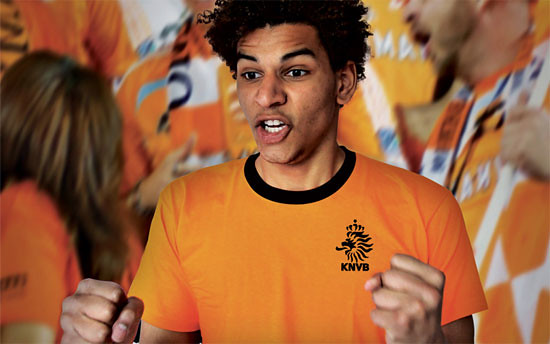
Don't say we don't provide a bit of variety here at Style Salvage. I've been lost in a world (cup) of football for the last week and a bit, only really thinking about clothes when the camera cuts to the managers' dugout but when I saw these football inspired tops (here), they made me smile and so I just had to share them. A clever use of clothing to brighten up your day!

Image by Milan Daniels

Amsterdam based creatives Bas Van de Poel and Daan Van Dam have created a range of t shirts in support of the Dutch Football Federation. Worn 'normally', they look like any other (bright orange) top... but when a player of the dutch team scores, the wearer can pull the front of their shirts over their heads to become one of the players.

Image by Milan Daniels


Hooray! Steve reckons it's a good thing that these aren't made with the England squad on them... they probably wouldn't sell as well with Rooney or Crouch's faces on them! Though even if they did make them, with the way that England have been playing so far I don't think we'd need to worry about celebrations too much...


Update: Erectizm has pointed out that this has been done before... when Getafe were sponsored by Burger King last year. It's slightly less cool when it's the Burger King's creepy face though!

Monday, 21 June 2010

Discovering Pitti: My Bob

Finding My Bob

There have been many golden eras where a man would consider an outfit incomplete, consider himself naked even, without a hat but now they are rarely even considered in the construction of the everyday outfit. As EJ mentioned in her campaign for hats, 'just look at the street scenes in almost any film made the 50s or earlier to see how commonly the hat used to be worn and how much better it makes almost everyone look.' However, the modern decline of hat wearing amongst men is obvious. I have to confess that despite admiring many hats from afar, I'm yet to fully commit to donning one. However, there is a great deal of inspirational hat donning out there and I stumbled across a wonderful hat brand on the very first morning of Pitti Uomo. My Bob's colourful arrangement of head wear instantly grabbed my attention on the lower level of the main exhibition space. Fortunately, the charismatic owner positively encouraged me to photograph his wonderfully crafted Panama hats while he talked me through his latest collection and how the Belgian brand came to be...

Quite possibly the perfect headwear for a warm Spring/Summer day.

My Bob's story began in 2008 when Geoffroy Moreels decided, thanks to his persuasive friend Hugo Machado, to launch a hat business with the famous panama hats from Ecuador. Moreels, a headdress collector from around the world, was very motivated to promote the spirit of the handmade panama hats. Quickly he convinced a number people about his project and needed to get the hats. He wanted to re style the classic panama hat, to give it a casual yet fun look in order to make it more colourful, sexy even. Now his creations are sold under the smile inducing banner "my bob, use your head!"

An ideal way to shield the sun from your face.

Last weekend John introduced me to the luxurious world of great craftsmanship behind Montecristi Panama hats. I have to concede that I am no expert on what makes a great Panama hat but My Bob's examples are certainly more appealing to my current sartorial aesthetic (not to mention I don't really have a spare $25k). A genuine Panama hat is weaved with "Carludovica Palmata" also called toquilla palm from the fabulous tropical jungle of the Ecuadorian Coast. Harvesters of the toquilla palm split the stem into narrow strands. These are cooked, dried and bleached before being passed to the weavers. They prepare the straw in the lengths they want and weave it to a fine Panama hat. After being woven, the excess straw is being cut. The hat is washed, bleached again and treated before being blocked into a nice shape. The Panama hat is completed with a sweatband and ribbon.

Such a variety of colour of trimmings.

So, despite the name, genuine Panama hats are in fact made in Ecuador, not Panama. The origin of the name is uncertain. However, the Oxford English Dictionary cites a use of the term as early as 1834. When the Spanish conquerors arrived to what nowadays are known as the provinces of Guayas and Manabí on the Ecuadorian coast. They observed native Indians using straw hats which covered their ears and necks. These hats looked like headdresses, similar to those used by the nuns or widows in Europe at the time. It is this similarity that gave the hats the name of "Toquillas" (headdress in Spanish) and resulted in the straw from which they were made to be called "Toquilla Straw". According to legend, the hat became associated with Panama during the construction of the Panama Canal in 1913. During the event Teddy Roosevelt received an Ecuadorian straw hat as a gift. Without knowing the true origin, the American president thanked his guests for the gift mentioning it as a "Panama Hat" and wore such a hat, which increased its popularity. We know today that the "Panama Hat" is made in Ecuador with the secrets for the elaboration of the hat passing from generation to generation. Each hat is unique and totally artisanal! A few seasons in and Moreels has continued to add to his colourful range...

This hat is entirely reversible but I love the baby blue hue of this side.

These examples are a great way to add colour to any Summer outfit.

Just a taster of My Bob's diversity

This collection of hats certainly turned my head at Pitti and I'm sure they'll turn a few of yours but hopefully we'll see a few proudly sitting atop. With the help of passionate hat wearing gentleman such as Geoffroy Moreels of MyBob, the time for a new era of hat wearing is now.

Epsom BA Graduate Showcase: Lewis Chong

Over the last few weeks we have introduced a number of our favourite Menswear design students from colleges throughout the UK and beyond. Having attended Graduate Fashion Week last week my blinkered eyes have opened up to a talented contingent of graduates from other disciplines. None more so than than the finalists for the Hammerson Fashion Innovation Award which all graduated from the UCA Epsom. Now, I am fascinated by the different perspectives on what the future holds for traditional print magazines. Be it the rise of fanzines or the evolution towards mooks, the magazines that have provoked a collective sense of ennui in recent times with either evolve or die.

The Hammerson Fashion Innovation Award restores my faith in the future of fashion journalism. One of my favourite finalists was Lewis Chong who was nominated for a magazine project based on augemented reality, Binary. In his editor's letter, Chong describes the seductive, tactile nature of paper and mentions how this has often been a stumbling point for the new wave of digital magazines. His solution uses the ingenious method of augmented reality as access points to the content, both in fun and easy sticker form and in limited edition digitally printed polo shirts, allowing Binary to combine the physical with the virtual (a demonstration video can be viewed here). Here we talk to the talented graduate to learn more about his project, his thoughts on the industry and his hopes for the future...

The front page of Binary.

SS: What was the driving catalyst for Binary magazine?
Lewis Chong: As much as I love printed magazines, I wanted something else with Binary. A few ideas where thrown about then I started looking at augmented reality and realised it would be the perfect device, and the interactivity does compensate somewhat for the loss of paper.

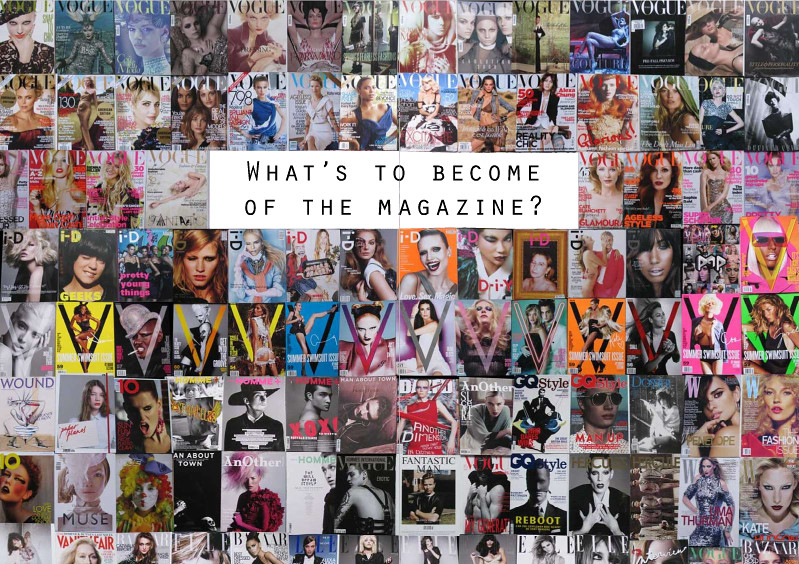
SS: What's to become of the magazine?
Lewis Chong: There is a whole investigative feature in Binary about what's to become of the magazine. To be honest, it's pretty hard to try suggest what the future holds but we can have an educated guess. The amount of jobs or opportunities around now for graduates, apart from internships, is pretty bleak so people need to get together and start new ventures. The popularity and power of the internet is incredible and I think it's only going to develop further.
What's to become of the magazine?

SS: You mention that you've grown tired of magazines but that hasn't always been the case. What were the magazines that you just had to buy each month, quarterly or biannually? Which magazines have you loved over the years? Are there any today that still excite and inspire you?
Lewis Chong: As I specialised in fashion journalism I've always tried to read a wide variety of publications. My first real love was POP magazine when it was under Katie Grand. It had never even crossed my mind before that fashion, style and writing could combine in such a way. That's why I was especially pleased when Katie said she would contribute to Binary.

Generally, the magazines I tend to buy are Italian Vogue and V magazine for the visuals, Fantastic Man and Hercules for the men's fashion, National Geographic for the photography and New Scientist for the articles.

The Kim Jones interview is a great read

SS: Binary uses the ingenious method of augmented reality as access points to the content, both in fun and easy sticker form and in limited edition digitally printed polo shirts, allowing Binary to combine the physical with the virtual. What attracted you to this type of technology in particular?
Lewis Chong: What particularly interested me was its simplicity. The paper and the technology, it's almost like some sort of virtual origami.

SS: How did the collaboration with CSM MA student Shaun Sampson arise and how did the collaboration develop?
Lewis Chong: Shaun is a friend of mine, he has worked with the designer Jeremy Scott for a few years previously and he was the ideal designer to represent the magazine: he's young, ambitious, skilled and has a brilliant outlook on the world.
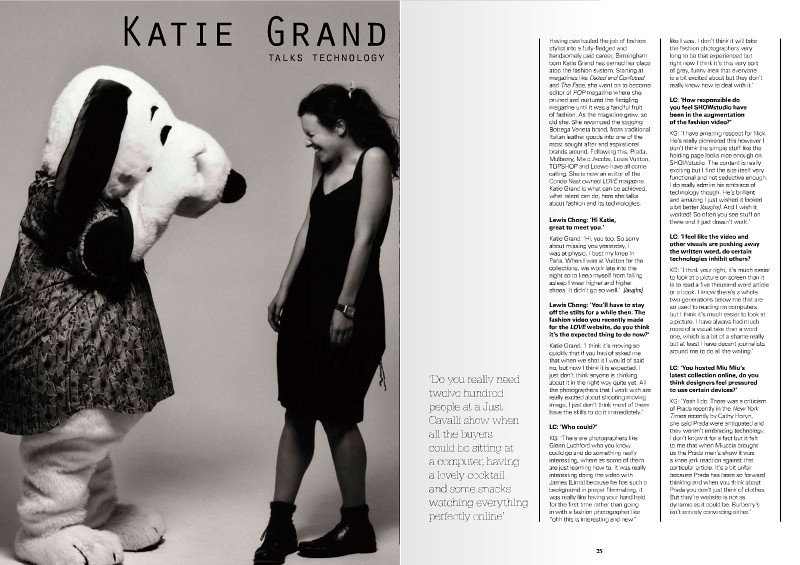

Katie Grand talks technology

SS: With fashion, innovation and modernity in mind, the contents include a fabulous talk with Katie Grand on technology, a catch up with Kim Jones and Tim Blanks discusses conspiracy. For a debut issue the content is remarkable, made even more so by the fact that all written content was created by you. Talk us through the experience of creating Binary. What were the highlights?
Lewis Chong: The accumulation of my thoughts and ideas that were realised in the magazine was the best part about making it. Each interview in the magazine was done in person, to provide that intimate touch, and I am really thankful to everyone who contributed. It is not only the case that they are respected faces within the industry, they are intriguing individuals with insightful opinions. Binary definitely wouldn't of been the same without them.

The Tim Blanks interview is wonderfully odd.

SS: I'm going to appropriate one of the questions you asked Katie Grand....How well do you think fashion binds with technology?
Lewis Chong: The technology used to create the clothes we wear does develop. Better machines with better dyes using better operating systems, but I don't know, fashion and technology in my mind only seems to help create an image of how to make clothes even faster, even more mass produced and I don't think this is the way forward. The technology we have should be used to help personalise fashion again, with less of the dispensable, throw away notion we have now.
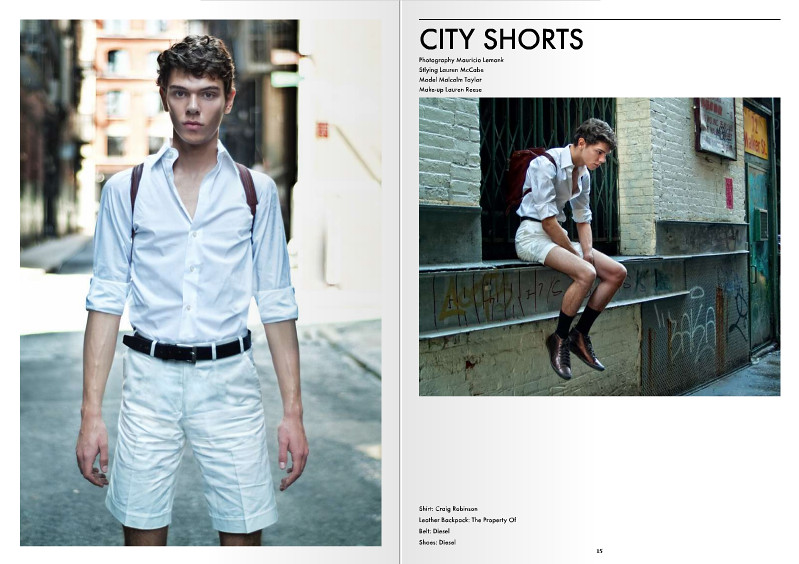
One of the three editorials, City Shorts.

SS: With the emergence of breathtaking fashion films and greater accessibility of fashion shows thanks to live feeds, we've seen a discernible shift in recent seasons. What has been your take on the approach of the large fashion houses? How do you see it developing?
Lewis Chong: I can only see the presence of the fashion film increase. As shows become more and more costly to produce, other options are bound to arise. Especially for more emerging designers, who cannot afford to present a collection or even compile a printed look book, will turn to the video. How long though before the medium has been over saturated?
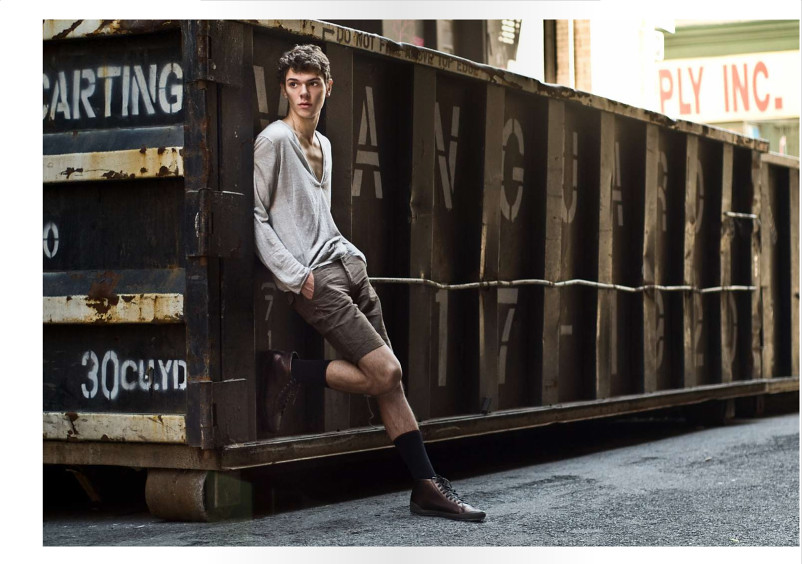
One of the three editorials, City Shorts.

SS: Finally, what next? What would you like to achieve in latter half of 2010 and beyond?
Lewis Chong: What's next? Hopefully I'm looking to produce another issue of Binary and hopefully publish some of my written work elsewhere.
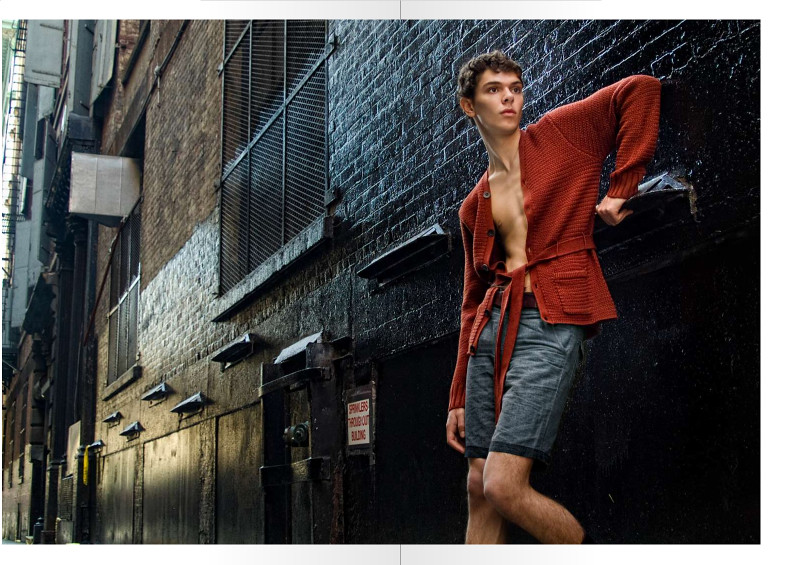
One of the three editorials, City Shorts.

----------

With the emergence of breathtaking fashion films and greater accessibility of fashion shows thanks to live feeds, we've seen a discernible shift in recent seasons towards technology. How magazines exist in the modern world is intriguingly uncertain. That said, I'm quite sure they will exist in a myriad of forms and will continue to be enjoyed by many.

Sunday, 20 June 2010

Shooting Men at Pitti

I have long admired the snapshots of style that Tommy Ton captures for his own site Jak & Jil and those for GQ. His images are at times breathtaking and frequently more inspiring than the happenings of any catwalk. However, I have rarely been afforded the opportunity to observe Tommy's eye in action. Pitti Immagine allowed such a chance. When taking a breather from our intensive exhibition hunting we often found Tommy in his well placed observation seat aiming his camera at the details of the dapper. I was amazed at how focused he is in work mode and loved watching him in action. His roving eye scans and focuses on suspects akin to the likes of Robocop and the Terminator (thankfully no subjects were harmed during this shooting.) Despite a good number of distractions and the constant threat of a torrential downpour, Tommy would zoom in on a contrasting cuff, tailoring quirk, novel print combination and sartorial scenes from one hundred paces. This season his numerous snapshots will provide a great deal on inspiration for you. Below are a few of my favourites...

This colourful fellow is the quintessential Pitti gentleman. I love how he has carefully selected a matching female companion.

This season, my favourite ensembles showcased the double breasted suit in all of its varied forms. This one is truly special.

The more I look at it this shot, the more I like and want to emulate.

This shot of tailoring and technology teamed up was one of Tommy's personal favourites.

Now this is a masculine clutch bag.

These legs and shoes look familiar...

Sam (as informed by the Sartorialist) was consistently one of the best dressed men at Pitti.

The art of clashing. Plaid and various stripes combine wonderfully.

We have long declared that the real beauty of menswear is in the details and will never tire of taking the time to celebrate the finer details of men's style, thanks to Tommy Ton we can.

Haider Ackermann's A Carte Blanche Called 'Opium'


Haider Ackermann's Carte Blanche event "Opium" was part of Pitti W last week but it has taken me a few days to recover myself. The presentation of his womenswear pre-collection and S/S 11 menswear debut was a visual feast packed full of surprises. Ackermann hosted a lavish evening of fashion, performance and celebration in the deserted Palazzo Corsini on the edge of the Arno river in Florence. The event could not have been further from anything else I had seen at Pitti Uomo that day. In a wonderfully unique combination of the baroque surroundings and the bohemian spirit of Haider, guests enjoyed a champagne reception and exotic fruits, followed by a piano concert and then fashion parade in a chandelier lit courtyard...

Entitled “A Carte Blanche named "Opium", the showcase was a romantic homage to a traveling woman and her man alone in the deserted Palazzo, channeling a gypsy spirit of North Africa. The menswear itself was a complete surprise. With a womenswear line known for sensual, attenuated androgyny we expected more of the same for his debut menswear offering. Instead we were treated to an array of embroidered textiles and textures reminiscent of a grungier Dries Van Noten.


Layered loose fabrics of alternating textures and shades held a masculine grace and a relaxed grunge, belted and folded to reveal a gradient of colour, and an imbalance of lengths and proportion. This was a modern eclectic traveling wardrobe. Ackermann's inspirations and muses were Jean Genet, Arthur Rimbaud, Oscar Wilde and Emperor Hailie Selassie...here the ghosts of these characters gathered...

In addition to the opulent fruit fare available prior to the show, piles of silver lined books lay for our perusal. These were Haider’s limited edition inspiration books which were especially printed for the occasion. With a poetic preface written by Francesco Bonami, the tome is rich with content from many of Haider’s idols, friends and frequent collaborators including Paolo Roversi, Robert Mapplethorpe, Berlinde de Bruckyere, Antony & the Johnsons and Tilda Swinton. It includes an image from The Emperor, the mesmerizing book by Ryszard Kapuscinski on the last days of Ethiopia’s last Emperor Hailie Selassie, mirrors Ackermann’s universe perfectly:

“I see him now as he walks, stops, walks again, lifts his head upward as though absorbed in prayer. O God, save me from those who, crawling on their knees, hide a knife they would like to sink into my back. But how can God help? All the people surrounding the Emperor are just like that – on their knees, and with knives. It’s never comfortable on the summits. An icy wind always blows, and everyone crouches, watchful lest his neighbour hurl him down the precipice."

With so much of fashion shifting towards a form of minimalism, Haider Ackermann's embroidery-encrusted jackets and patched jacquards were a pleasant surprise. Ackermann used fabrics and textiles that I wanted to reach out, manhandle and steal. During the show, while I was in a state of sartorial shock and longing, Susie managed to snap a few close ups of the collection...

One of Ackermann's embroidery-encrusted jackets

Beautiful silks

I might have been seduced by the setting but I adore these embroidery heavy trousers.

I love this peacock effect print.

A closer look at the array of textiles on show...

Both the menswear and womenswear were teamed with slippers embellished with layers of peacock feathers, silver beading and leopard satin.

There were undoubtedly shades of early Dries Van Noten and whiffs of Dolce and Gabbana's 1990s shows. Showstudio's Alex Fury mentioned that it had been some time since we have been treated to loose silhouettes, exotic fabrics, ethnic embroidery and cultural mismatching such as this. I for one would like to join Ackermann's nomadic tribe.

Saturday, 19 June 2010

Ging Gang

As mentioned previously, for as long as I can remember I have dreamed about wandering the stalls and observing the impeccably dressed gentleman in all of their pomp and glory at Pitti Uomo. For a number of seasons I have marveled at the wonderfully tailored peacocks on the pages of the Sartorialist and GQ. Knowing that I would finally walk amongst these well cut specimens was enough to provoke a touch of nervousness. Sweaty palms and frog in throat aside, I was confident that the contents of my suitcase would not let me down. There was one outfit that I was particularly proud of...

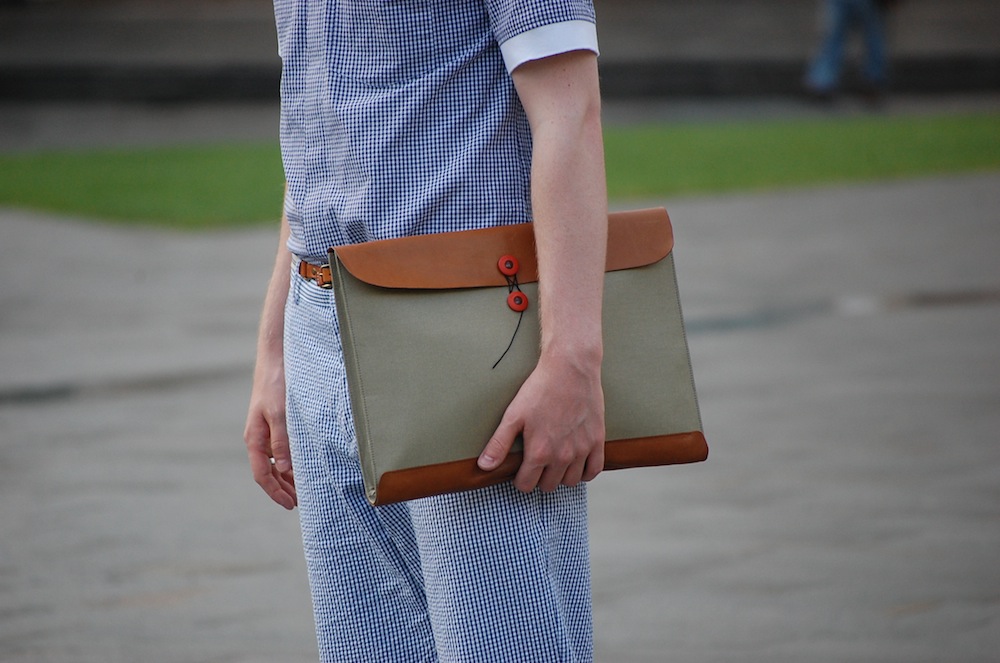
Gingham shirt and trousers by b store, made to measure jacket from j.a. daye, belt from Moustache, glasses by Bruno Chaussignand, document folder by Postalco and hand punched leather brogues by Joe Casely-Hayford for John Lewis.

With the idea of an English gentleman abroad bouncing around my excited brain, I decided to breathe fresh life in to my holiday wardrobe and picked up two gingham pieces from b store to help me accomplish the desired aesthetic. My Summer ensembles tend to suffer the moment the eye gazes to the bottom half but I first saw a pair of trousers that could solve my problem at b store. Their 'Basil' gingham trousers are the ideal lightweight option for the warmer months. A week after solving my trouser predicament I ventured back to my favourite London store to cover the launch of their Summer "shop in shop" venture. Once inside I could not resist picking up the matching gingham shirt.

Gingham shirt and trousers by b store, belt from Moustache, document folder by Postalco and glasses by Bruno Chaussignand

Having gone all out gingham I just had to research the origins of this all too familiar and versatile fabric. Gingham fabric was first produced in the 17th century in England and shipped to the colonies. It was originally striped, but gradually came to be a checkered fabric. A popular colour combination for gingham has always been blue and white. There is however some disagreement about where the word gingham came from. Some argue that it is from the Italian "ging-gang," while others cite the Malaysian word "genggang." Still others argue that it stems from an Indonesian word. What all the possible roots have in common is that they all mean "striped." The fabric can be made using wool, silk, or linen or any synthetic fiber as well. Of course it is also possible to find "gingham" printed on oilcloth or vinyl for use as tablecloths.Currently, I just cannot get enough of it.

A closer look at the details...Gingham shirt and trousers by b store, belt from Moustache and document folder by Postalco.

The eagle eyed amongst you might have noticed my inclusion on Tommy Ton snaps Pitti Uomo over on GQ (if not here I am and here is my bottom half). If you've been following Tommy's Pitti snaps you'll know just how many fabulously dressed men there are strutting down the paths of the trade show. Never in my wildest dreams did I think I would appear alongside such well dressed men. I'm nowhere near the level of most of them but I'll nevertheless savour the sartorial association.

Gingham trousers by b store and hand punched leather brogues by Joe Casely-Hayford for John Lewis.

LinkWithin

Related Posts with Thumbnails